Where Does Your Enterprise Stand in the AI Age?
Artificial intelligence (AI) has transitioned from an internal productivity accelerator to the core determinant of corporate market advantage, strategic decision velocity, and customer trust. However, rapid AI integration raises three critical executive questions:
🔒 Reliability
How verifiable, accurate, and secure are the models and generative algorithms deployed across your workflow?
⚖️ Risk Governance
How does your leadership govern intellectual property rights, data leakages, algorithmic bias, and compliance liabilities?
🌱 Responsible Ethics
How can you verify to clients, regulators, and boards that your AI deployment is fundamentally ethical and compliant?
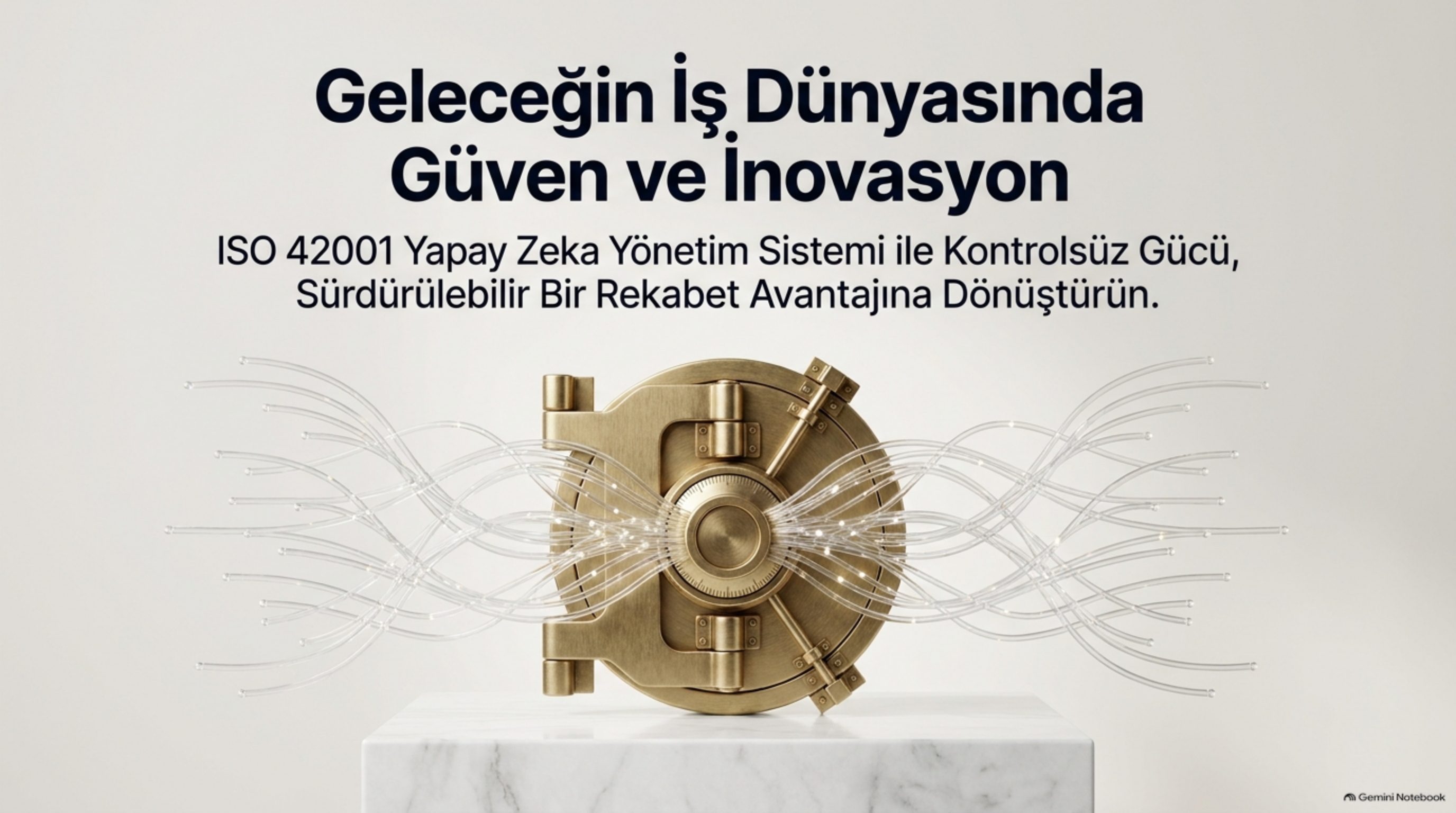
Just as ISO 9001 establishes process quality and ISO 27001 safeguards information security, ISO/IEC 42001 represents the definitive international benchmark for artificial intelligence integrity—certifying that enterprise AI adoption is transparent, risk-assessed, and audit-ready.
11-Page ISO 42001 Executive Presentation
Explore the operational dynamics, regulatory intersections, and strategic governance pillars of the AI Management System in our interactive slide deck:
Strategic Value for Your Enterprise
🏆 Market Authority & Trust
Demonstrate to multinational partners that your enterprise leverages AI with audited ethics, transparency, and data integrity.
🇪🇺 EU AI Act Statutory Compliance
Gain immediate structural alignment with the stringent compliance mandates enforced by the European Union AI Act and international regulations.
🛡️ Algorithmic Risk & Bias Mitigation
Proactively eliminate prompt leakages, algorithmic copyright breaches, unvetted training sets, and model hallucinations.
🚀 Competitive Tender Advantage
Enterprise B2B clients demand proof of secure AI integration before vendor onboarding; ISO 42001 unlocks global enterprise procurement.
Who Needs ISO 42001 Certification?
-
✓
AI Developers & Creators: Tech firms and software companies building proprietary models, algorithmic engines, or customized LLM solutions.
-
✓
Enterprises Integrating AI Workflows: Organizations applying generative AI and machine learning across marketing, customer service, underwriting, or production.
-
✓
Procuring Organizations: Companies purchasing AI-powered SaaS and third-party systems seeking to guarantee vendor data confidentiality.
Frequently Asked Questions
Our company uses commercial AI tools (ChatGPT, Microsoft Copilot); is ISO 42001 applicable to us?
Yes. The standard governs both AI creators and user organizations. It establishes critical safeguards to ensure employees do not upload trade secrets, proprietary source code, or customer PII into public AI models.
We hold ISO 27001 Information Security certification; do we still need ISO 42001?
ISO 27001 covers general data security, but it does not address AI-specific risks such as hallucination governance, algorithmic bias, automated decision ethics, model drift, and training data poisoning. ISO 42001 integrates cleanly with ISO 27001 to resolve this gap.
Will ISO 42001 slow down our innovation cycle?
On the contrary: a well-designed AI governance framework eliminates organizational hesitation, speeds up executive approvals, and ensures high ROI on AI investments without exposing the firm to regulatory fines.
Teknobel 5-Step AI Governance Roadmap
AI Diagnostic Gap Analysis
Comprehensive audit of current AI models, data pipelines, vendor agreements, and organizational risk exposure.
Integrated Governance Model
Designing tailored AI policies, approval matrices, and data handling protocols synchronized with ISO 27001 and ISO 9001.
Workforce Competency & Ethics
Practical employee training on prompt security, data hygiene, ethical AI boundaries, and copyright awareness.
Internal Audit & Verification
Full mock internal audit verifying model risk registries, impact assessments, and vendor safeguards.
Accredited Certification
Hands-on consultant accompaniment through third-party accredited audits to secure official ISO/IEC 42001 certification.